
Results
-
 £119.99
Landscapes - Bertrand Moren
Landscapes is a work structured around two main ideas. On the one hand, the music freely paints some of the superb landscapes I've seen during several of my trips around the world. Listeners should, however, not be influenced by this programmatic framework and are encouraged to build their own 'mind pictures'.On the other hand, Landscapes constitutes a test piece for each section of the brass band. Indeed, each musical landscape highlights a particular register. A small group of soloists is given the opportunity to fully display its skills in dialogue with the rest of the band (the tutti), hence the name 'concerto grosso'. Landscapes also relies on the band's different soloistmusicians when it comes to express highly complex, musically and technically challenging passages.
Estimated dispatch 5-14 working days
-
 £42.95
Day of the Spiritual - Brian Bowen
Early African-American songs contain a wealth of human expression, based on a yearning for freedom and biblical deliverance. This rhapsodic work combines Spirituals and Blues as the composer visualises a Camp Meeting where ecstatic utterances and spontaneous solo outbursts occur. These eventually become disorderly and uncontrollable, leading to a frenzy and collapse. With order and calm resorted, the music leads to an exultant conclusion. Included: I Stood on the River of Jordan - Balm in Gilead - Michael, Row the Boat Ashore - Wade in the Water.
Estimated dispatch 5-14 working days
-
 £84.99
Gandalf the Wizard - Johan de Meij
Johan de Meij's first symphony The Lord of the Rings is based on the trilogy of that name by J.R.R. Tolkien. This book has fascinated many millions of readers since its publication in 1955. The symphony consists of five separate movements, each illustrating a personage or an important episode from the book. This transcription for brass band, arranged by the composer has the following movements: I. GANDALF (The Wizard), IV. JOURNEY IN THE DARK (The Mines of Moria and The Bridge of Khazad-D m), V. HOBBITS. The symphony was written in the period between March 1984 and December 1987, and had its premiere in Brussels on 15th March 1988, performed by the The Royal Band ofthe Belgian Guides under the baton of Norbert Nozy. In 1989, the symphony The Lord of the Rings was awarded a first prize in the Sudler International Wind Band Composition Competition in Chicago, and a year later, the symphony was awarded a grant by the Dutch Composers Fund. In 2001, the orchestral version was premiered by the Rotterdam Philharmonic Orchestra and recorded by the London Symphony Orchestra.
Estimated dispatch 5-14 working days
-
 £89.99
Journey in the Dark - Johan de Meij
Johan de Meij's first symphony The Lord of the Rings is based on the trilogy of that name by J.R.R. Tolkien. This book has fascinated many millions of readers since its publication in 1955. The symphony consists of five separate movements, each illustrating a personage or an important episode from the book. This transcription for brass band, arranged by the composer has the following movements: I. GANDALF (The Wizard), IV. JOURNEY IN THE DARK (The Mines of Moria and The Bridge of Khazad-D m), V. HOBBITS. The symphony was written in the period between March 1984 and December 1987, and had its premiere in Brussels on 15th March 1988, performed by the The Royal Band ofthe Belgian Guides under the baton of Norbert Nozy. In 1989, the symphony The Lord of the Rings was awarded a first prize in the Sudler International Wind Band Composition Competition in Chicago, and a year later, the symphony was awarded a grant by the Dutch Composers Fund. In 2001, the orchestral version was premiered by the Rotterdam Philharmonic Orchestra and recorded by the London Symphony Orchestra.
Estimated dispatch 5-14 working days
-
 £89.99
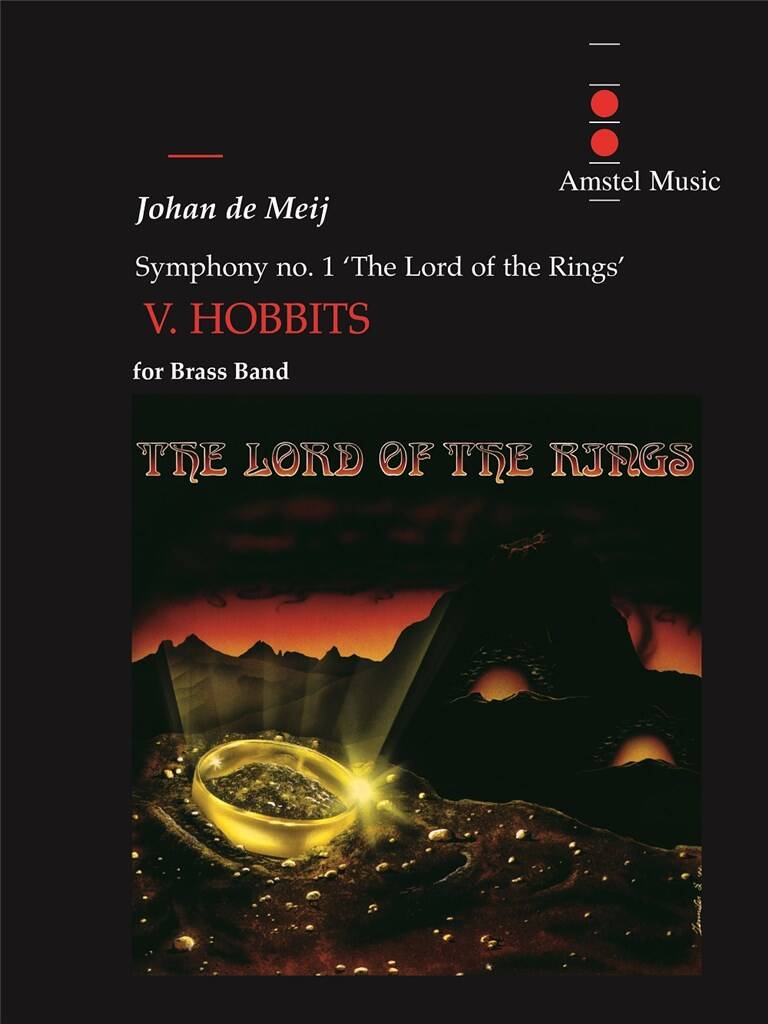
Hobbits - Johan de Meij
Johan de Meij's first symphony The Lord of the Rings is based on the trilogy of that name by J.R.R. Tolkien. This book has fascinated many millions of readers since its publication in 1955. The symphony consists of five separate movements, each illustrating a personage or an important episode from the book. This transcription for brass band, arranged by the composer has the following movements: I. GANDALF (The Wizard), IV. JOURNEY IN THE DARK (The Mines of Moria and The Bridge of Khazad-D m), V. HOBBITS. The symphony was written in the period between March 1984 and December 1987, and had its premiere in Brussels on 15th March 1988, performed by the The Royal Band ofthe Belgian Guides under the baton of Norbert Nozy. In 1989, the symphony The Lord of the Rings was awarded a first prize in the Sudler International Wind Band Composition Competition in Chicago, and a year later, the symphony was awarded a grant by the Dutch Composers Fund. In 2001, the orchestral version was premiered by the Rotterdam Philharmonic Orchestra and recorded by the London Symphony Orchestra.
Estimated dispatch 5-14 working days
-
 £105.20
Lullaby for small goblins - Gudny Hagen - Philip A. Kruse
"Amalies Christmas" is a Norwegian TV series for children, produced by NRK in 1995, and broadcasted again in 19976, and in 2000.The program consisted of 24 episodes, and follows Amalie Wang (Anne Marie Ottesen) making preperations forChristmas in an old house where there lived goblins. The program was the first of many to follow, based on the author Gudny I. Hagens characters. The music is composed by Philip A. Kruse, and all episodes ended with the goblin family (HaraldHeide-Steen jr., Brit Elisabeth Haagensli og Pia Borgli) singing "Lullaby for small goblins".This arrangement for young concert band may be performed with different instrumental soloist or vocalist.Chords are included for piano/guitar. It isimportant to focus on the dynamics and the tempo. The soloist must be heard clearly and adding a choir in the refrains makes it even nicer. It is a melodic song that suits being performed in churches and rooms with ambience. The song is often usedaround Christmas time, but it is written as a small lullaby that can be played anytime.
Estimated dispatch 5-14 working days
-
 £84.99
Christmas Brass - Richard Peaslee
Christmas Brass is a fantasy on six carols, originally commissioned by Mark Freeh for the Manhattan Brass Choir. Duration: 16:30The well-known tune, O Come, O Come Emmanuel, a hymn originally based on a plainsong melody, is here set in 5/4 meter. Modal harmonies are combined with big band style as the piece gains momentum, greatly accentuating the mood of the words, "Rejoice! Rejoice! Emmanuel." The opening 5/4 statement of the theme returns, and the piece ends quietly.In Beautiful Savior (also known by the title Fairest Lord Jesus), a hushed beginning featuring horns, euphoniums, and a muted trumpet, leads through a key change to a satisfying, chorale-likeclosing passage.In Away in a Manger, Peaslee sets two tunes, Cradle Song and Away in a Manger. Following a straightforward presentation of each melody, Peaslee plays them against one another. The music swells to a full climax followed by a hushed ending.Peaslee employs a gentle hand in It Came Upon a Midnight Clear, using flugelhorn solos and duets in a jazz-waltz style.In Silent Night, the traditional carol gets an untraditional harmonization, propelled forward by give-and-take between the two groups of brass instruments in the brass choir: trumpets and trombones versus horns, euphoniums, and tuba.Hark! The Herald Angels Sing begins with a humorous blast of discordant harmonies as multiple carols are sounded at the same time. An up-tempo 4/4 announcement of the melody in the trombone is followed by a metrical modulation in 6/8-3/4 time. An additional metrical modulation bring the music back into 4/4, but at a slower tempo and in a pronounced jazz style. Tempo I returns, and the set of six pieces closes with a big ending.Instrumentation: 4 Trumpets, 2 Horns in F, 4 Trombones, 2 Euphoniums, Tuba, Guitar, Bass, Percussion
Estimated dispatch 5-14 working days
-
 £109.99
Nordic Moods - Tom Brevik
The composer:1st movement: Reflections by the Fjord.Overlooking one of the mighty fjords of Norway, my mind and thoughts are with an old religious Norwegian folk-tune, with words by the famous parson Peter Dass.The majestic fanfare-likeopening reflects the power of God our Father, the choral itself heard for the first time on flugelhorn. The choral is repeated a few times, separated only by some short variations. The movement ends in thriumph, with fanfares and the choral broughttogether.2nd movement: Reflections in the Old Church.In this movement my associations of a summer day, finding myself alone in an old deserted stone church. From the old walls I hear folk songs, perhaps like the ones sung in the church bypoor fishermen and farmers in days gone by. Suddenly the light from the sun breakes through the small circular window above the altar, and a lovely melody is heard, before the original figures take us to the end of the movement.3rd movement:Festive Reflections.Any festive occasion can be reflected in this movement. from the bonfire at midsummer-night to the children celebrating the return of the sun in the northern part of Norway. from the traditional sleigh-riding at Christmas tothe Celebrations of the National Day on the 17th of May each year.
Estimated dispatch 5-14 working days
-
£60.99
Cowboy Suite - Alan Laken
In the tripartite 'Cowboy Suite' Alan Laken takes us to the Wild West, the domain of cowboys, indians, trappers and other fortune hunters. Around 1890 the west coast of America was reached, which in effect meant the end of the Wild West. Its stories, however, survived and have been a source of inspiration for many books, films, and, of course, music. Some characters, such as Jesse James, Billy the Kid, and Buffalo Bill are forever linked to these tales. In the 'Cowboy Suite' we first hear the 'Hoedown'. At the end of an exhausting workday the labourers used to lay down their tools, among others the 'hoes' and spontaneously began to play music on the instruments which they then possessed (guitars, fiddles, and banjos) and to dance. After being jolted on the 'Wagon Trail' we reach the third part, the 'Cowboy Roundup'. In this last part it becomes clear that as a cattle driver it is imperative to stay firmly seated in the saddle. As the cattle are rounded up, i.e. driven together, spectacular things happen.
Estimated dispatch 5-14 working days
-
 £115.60
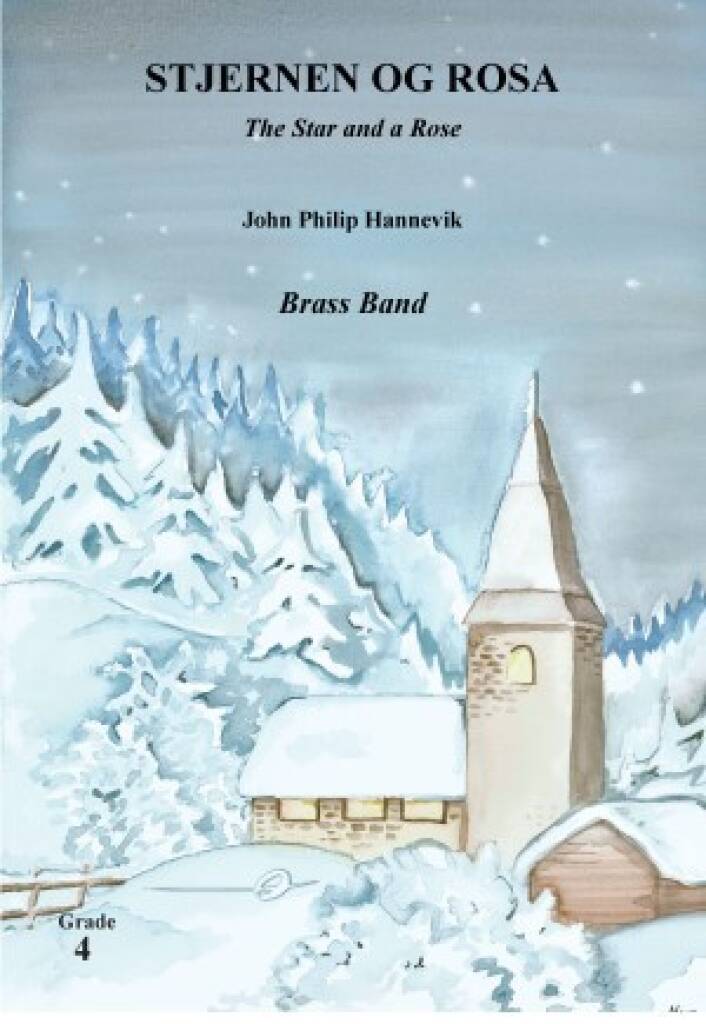
Stjernen og Rosa - John Philip Haqnnevik
The Star and a Rose is a big-scale Christmas piece for band, featuring four seasonal chorales.The first is a Gregorian-like chant Hodie Christus natus est.In this section of the piece, a soloist can be placed away from the band, maybe on a gallery. The soloist can be a tenor instrument, maybe trombone, or you can feature a vocal soloist.After this, the music leads us on to the old German Christmas chorale Lo, how a rose e'er blooming. This song is given a fairly rhythmical treatment, but make sure that the melody is presented in a cantabile style.An interlude follows, before the piece presents one of the most used and loved Scandinavian Christmas chorales, Mitt hjerte alltid vanker (My Heart will always wander), composed by the Danish bishop Hans Adolph Brorson around 1732. This song is building towards a climax, before the solo horn brings it all down to the Stable view described in the lyrics.Then comes a transition that brings us in to the final section of the piece, which presents the international Christmas Carol Adeste Fideles. As many will notice, I have borrowed a section from David Wilcocks majestic harmonization towards the end.The title of the piece has its background form the lyrics in My heart will always wander, where the text speaks about the stars in the sky. But also in the latin text for Adeste Fideles:Stella duce, Magi, Christum adorantesThe Rose is of course from the lyrics in the chorale Lo, how a Rose.
Estimated dispatch 5-14 working days
 View Music